For years, Zero Data Retention (ZDR) seemed like a solved problem.
Sign the agreement, enable the setting, and your prompts and outputs are processed without being stored. Security reviews got shorter. Legal teams relaxed. Banks, hospitals and insurers moved ahead with AI.
That world is gone.
In 2026, ZDR is not one promise. It is a patchwork of policies that change by provider, by model and even by API endpoint. And in the last six weeks, five separate provider incidents showed something worse: even where a policy exists, you often have no way to verify it.
If your product sends customer data to more than one model, you are living under several retention policies at once, usually without a clear view of what is stored, for how long, or which exceptions apply. Most teams have not accounted for that gap.
This post covers what changed, what the recent incidents revealed, and why privacy has to be enforced in your architecture instead of in each provider's settings. The answer is a trusted inference layer between your app and every model you call. That is what SPRO is built to be.
First, What ZDR Actually Means
ZDR is a commitment from a model provider that your prompts and the model's responses are not stored once the request is processed.
It matters because without it, most providers keep a copy for a while:
- OpenAI says abuse monitoring logs are generated for all API usage and retained for up to 30 days by default. ZDR is only available to eligible customers after approval.
- Anthropic says it deletes API inputs and outputs within 30 days, unless a ZDR agreement is in place, a Usage Policy issue requires longer retention, or the law requires it.
- Google says it keeps Gemini API prompts, context and outputs for 55 days to detect policy violations.
None of this is sinister. Abuse monitoring has a real purpose. But a prompt kept for 30 or 55 days carries every customer name, account number, internal document and sensitive detail inside it for the same period.
Why 2026 Changed Everything
1. Courts can force providers to keep data
In May 2025, a US court ordered OpenAI, as part of the New York Times copyright case, to preserve output logs that would otherwise have been deleted. That included API outputs that normally lived for 30 days. OpenAI fought the order and said customers on a ZDR agreement were not affected, because their data was never stored.
That is the key lesson of ZDR: data that is never stored cannot be preserved, subpoenaed or leaked later.
2. The most capable models now come with retention
On 9 June 2026, Anthropic's data retention policy for Covered Models took effect. Prompts and outputs for these frontier models are kept for 30 days for safety work. The policy targets organisations that had set up ZDR workspaces or reached Claude without retention through cloud platforms. Anthropic says no personnel can read retained conversations by default, and that data is deleted after 30 days unless it is flagged or legally required.
Anthropic itself expects this to be unpopular with customers who got used to zero retention, as reported by The Next Web.
3. Providers are taking opposite approaches
In August 2026, OpenAI previewed Private Safety Processing. It is designed to catch misuse across multiple interactions while keeping ZDR intact, and staff never see the underlying content.
So in one year, one frontier lab moved toward retention for safety, and another moved toward safety without retention. Both positions are defensible. They are also different. And your app may be calling both.
4. Even "ZDR" has endpoint-level fine print
OpenAI notes that ZDR-ineligible endpoints or capabilities may still retain application state, even with ZDR enabled. Stored conversations, threads, files and vector stores follow different rules than a plain completion call.
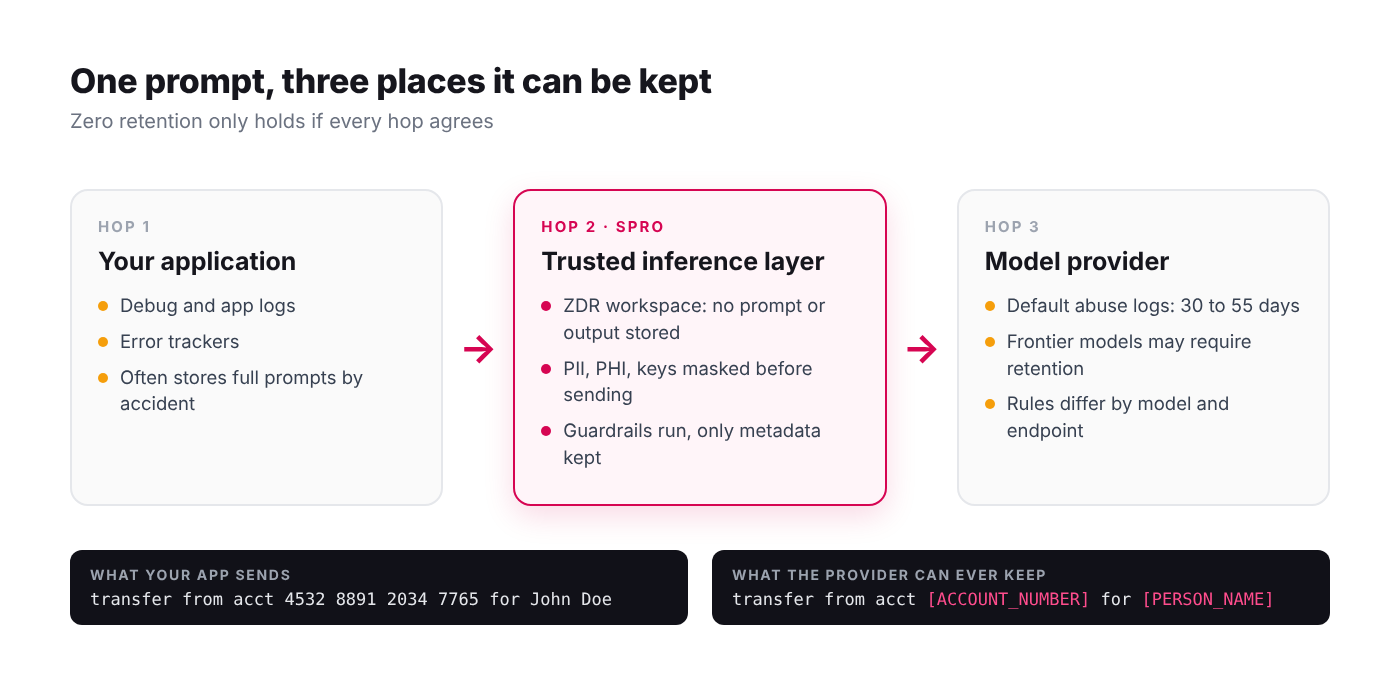
Figure 1. One prompt can be copied at several points: your app logs, the gateway or router, and the provider's abuse monitoring or safety retention window. Each hop has its own policy.
5. Then Five Incidents Showed the Label Isn't Proof
Policies are only half the story. In about six weeks, five different providers had incidents, and every one of them had a policy, a security posture or a ZDR label in place. None was caught by the provider's own monitoring. Each was found by someone outside, after the fact.
- Phala (serving DeepSeek V4 Flash for OpenRouter): an attacker had control of the server from Oct 21 to Nov 8, nearly three weeks before anyone caught it.
- GMI Cloud: an attacker accessed about three days of troubleshooting logs, with the exposure window spanning Oct 18 to Nov 18. Every GMI endpoint was shut off on Nov 20.
- Together AI: test samples of MiniMax M3, GLM-5.2 and Kimi K2.6 from June and July leaked after an AI coding agent committed a Hugging Face credential.
- Prime Intellect: someone with admin access swapped in a copy of DeepSeek V4.1 Flash with the refusals removed, from Nov 8 to 10. The provider cannot rule out that requests were read while the swapped model was live.
- MiniMax, via OpenRouter: a researcher planted unique tripwire URLs in prompts. Someone opened them 40 to 130 hours later. Some of those prompts had gone through endpoints labeled Zero Data Retention.
For OpenRouter's own account, see Data processing incidents on inference providers.
These are five companies with five different failure modes: a compromised server, accessed logs, a leaked credential, an insider-level model swap, and prompts read despite a ZDR label. The common thread is the trust model. Route through enough third parties and you are trusting each one's word, with no way to check it, until a researcher, an attacker or a committed credential proves it wrong.
A ZDR label is a statement about intent, not a guarantee about behavior.
The Real Problem: Retention and Exposure Happen at Every Hop
Most teams treat ZDR as a contract with a single provider. In reality, a prompt can be kept, or exposed, at every step it crosses:
- Your own application logs. Full prompts often end up here by accident during debugging.
- The router or gateway in the middle. It sees the full plaintext request and response. As we covered in Your Agent Is Mine, an intermediary that stores or reads everything is a serious risk on its own.
- The model provider. It applies its default window, its ZDR terms, or its special rules for frontier models.
- The provider's infrastructure behind it. Servers, troubleshooting logs, credentials and model-serving pipelines are exactly where Phala, GMI Cloud, Together AI and Prime Intellect ran into trouble.
If any one of these keeps or leaks a copy, you do not have zero retention. You have zero retention minus one.
There is a quieter risk too. Because rules differ by model, switching to a newer model can change your retention posture without a single line of your code changing.
What Each Incident Teaches
| Incident | What failed | What would have limited the damage |
|---|---|---|
| Phala | Server compromised for about three weeks | Sensitive data masked before it left your boundary |
| GMI Cloud | Troubleshooting logs accessed | Nothing sensitive in the prompts that end up in logs |
| Together AI | Credential leaked, samples exposed | Fewer plaintext prompts stored anywhere |
| Prime Intellect | Model swapped, requests possibly read | Masked inputs, plus visibility into which provider served each request |
| MiniMax | Prompts read despite ZDR labels | Not relying on the label alone |
The lesson is the same each time: assume any hop might keep or read a copy, and make sure the copy is worthless.
What a Trusted Inference Layer Does Differently
A trusted inference layer is a gateway that treats privacy as part of the request path, not a clause in a contract. It does three things a plain router does not:
- It stores nothing it does not need. The layer must not become one more place where your prompts pile up.
- It removes sensitive data before it leaves. If an account number never reaches the provider, the provider's retention window, servers or logs cannot expose it.
- It makes provider behavior visible. You can see which provider and model served each request, and send sensitive workloads only where the policy fits.
Where SPRO Fits
SPRO is a trusted inference layer: one OpenAI-compatible API in front of 350+ models, with privacy and guardrails applied to every request.
ZDR at the gateway
You can run any SPRO workspace in Zero Data Retention mode. Prompts, completions and attachments that pass through a ZDR workspace are not persisted. SPRO keeps only metadata, such as token counts, latency, status codes, model and provider, for billing and usage tracking.
ZDR is set per workspace. You can keep production customer traffic in a ZDR workspace while a development workspace keeps full logs for debugging. It works with both the Chat Completions and Responses APIs, including streaming, with no change to your integration code.
Guardrails that still run, without keeping the evidence
ZDR does not mean security is switched off. In a ZDR workspace, guardrails still run, and violations are recorded as metadata without the offending content. ML-based guardrails such as toxicity and hallucination detection run on SPRO's own inference models, not on third-party providers, per SPRO's data handling documentation.
Masking before the model ever sees the data
This is what protects you even when a provider retains data, or loses it. SPRO's Sensitive Information guardrail detects and masks PII, PHI, financial data and API keys before the prompt goes upstream:
Without protection:
Why did the transfer from account 4532 8891 2034 7765 for John Doe fail?
With SPRO:
Why did the transfer from account [ACCOUNT_NUMBER] for [PERSON_NAME] fail?If a provider holds that prompt for 30 or 55 days, or its server is compromised for three weeks, or its logs are accessed, or a tripwire URL gets opened, what is exposed is the masked version. If you do keep request history, the Anonymize Logs control masks sensitive values before logs are stored.
Visibility into where requests go
With SPRO you can see which provider and model served each request, and pin sensitive workloads to a supporting provider. With BYOK, you keep your own provider agreements, including ZDR terms, while SPRO handles routing, masking and guardrails.
Honest about the last hop
SPRO's ZDR covers what SPRO stores. Until its end-to-end ZDR rollout to upstream providers is complete, a serving provider may still briefly retain content under its own policy. No gateway can promise that a provider's servers will never be breached. What masking does is make sure that when a provider's promise or security fails, the data exposed is not the sensitive part.
Moving Off a Provider-Heavy Router
Switching is not a rewrite. It is usually a base URL change and a key swap, with model IDs mostly carrying over as-is. The step-by-step guide is here: Migrating from OpenRouter to SPRO.
from openai import OpenAI

client = OpenAI(
    base_url="https://spro.hridaai.com",  # from your SPRO dashboard
    api_key="YOUR_SPRO_API_KEY",    # a key from your ZDR workspace
)
Your existing code keeps working. The privacy controls move into the layer in front of every model.
Key Takeaways
- ZDR is no longer one setting. It varies by provider, model and endpoint.
- Default retention windows of 30 to 55 days are standard, and frontier models can carry retention even for ZDR customers.
- Five providers had incidents in about six weeks, and every one was found externally, not by the provider's own monitoring.
- A ZDR label is a claim, not proof. Prompts sent to ZDR-labeled endpoints were reportedly read anyway.
- Data that is never stored cannot be preserved by a court order, subpoenaed or leaked later.
- Retention and exposure happen per hop: your app, the gateway, the provider and its infrastructure.
- The most reliable protection is to mask sensitive data before it leaves and keep the inference layer itself free of stored content.
The Bigger Lesson
Provider policies will keep shifting, and providers will keep having incidents. Safety needs, legal cases and competition will keep pulling retention rules in different directions, model by model.
The teams that stay safe will not be the ones who read every policy update or trust every label. They will be the ones whose architecture does not depend on either.
Assume every model provider might keep a copy, or lose one. Then make sure there is nothing sensitive in it.
🚀 Explore SPRO
Ready to make zero retention something your architecture guarantees, not just something your contracts promise?
SPRO gives every request workspace-level Zero Data Retention, sensitive data masking and 29 guardrails, across 350+ models through one API.
🌐 Learn More
- 🛡️ SPRO : https://spro.hridaai.com/
- 🔀 Migrate from OpenRouter: https://spro.hridaai.com/docs/migrations/openrouter
- 📚 Technical Blogs and Research: https://www.hridaai.com/blogs
- 📅 Book a demo: https://www.hridaai.com/book-demo
Every model. Every request checked. Nothing left behind.